
Everything you need to know
from how we begin and progress, to the science supporting our approach, and answers to our most common questions.
What To Expect
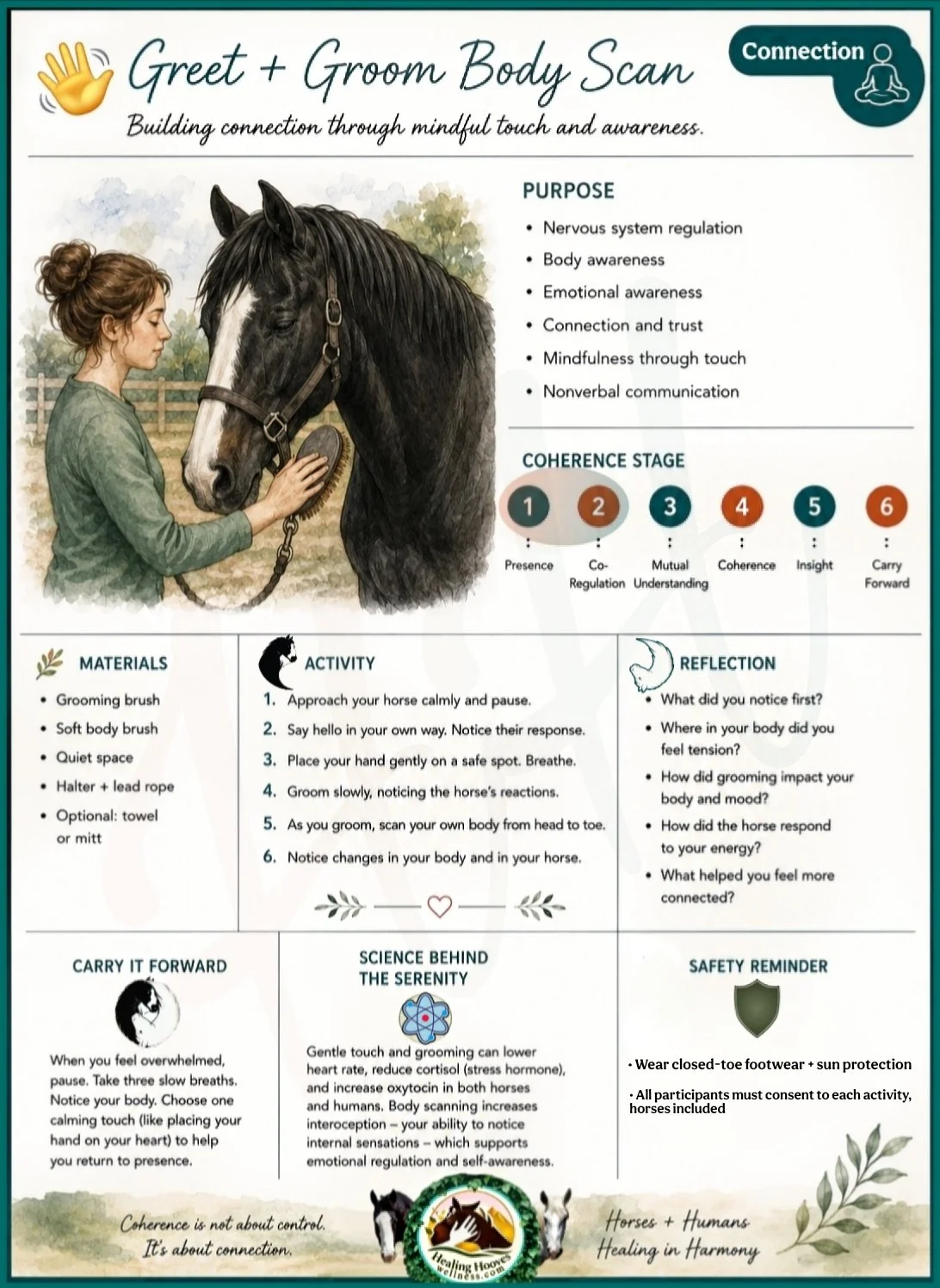
Initial introductions are the first building block to establishing trust and connection through quiet, mutual care. Gentle grooming encourages presence, body awareness, communication, and nervous system regulation while laying a healthy foundation for partnership.
Greet + Groom
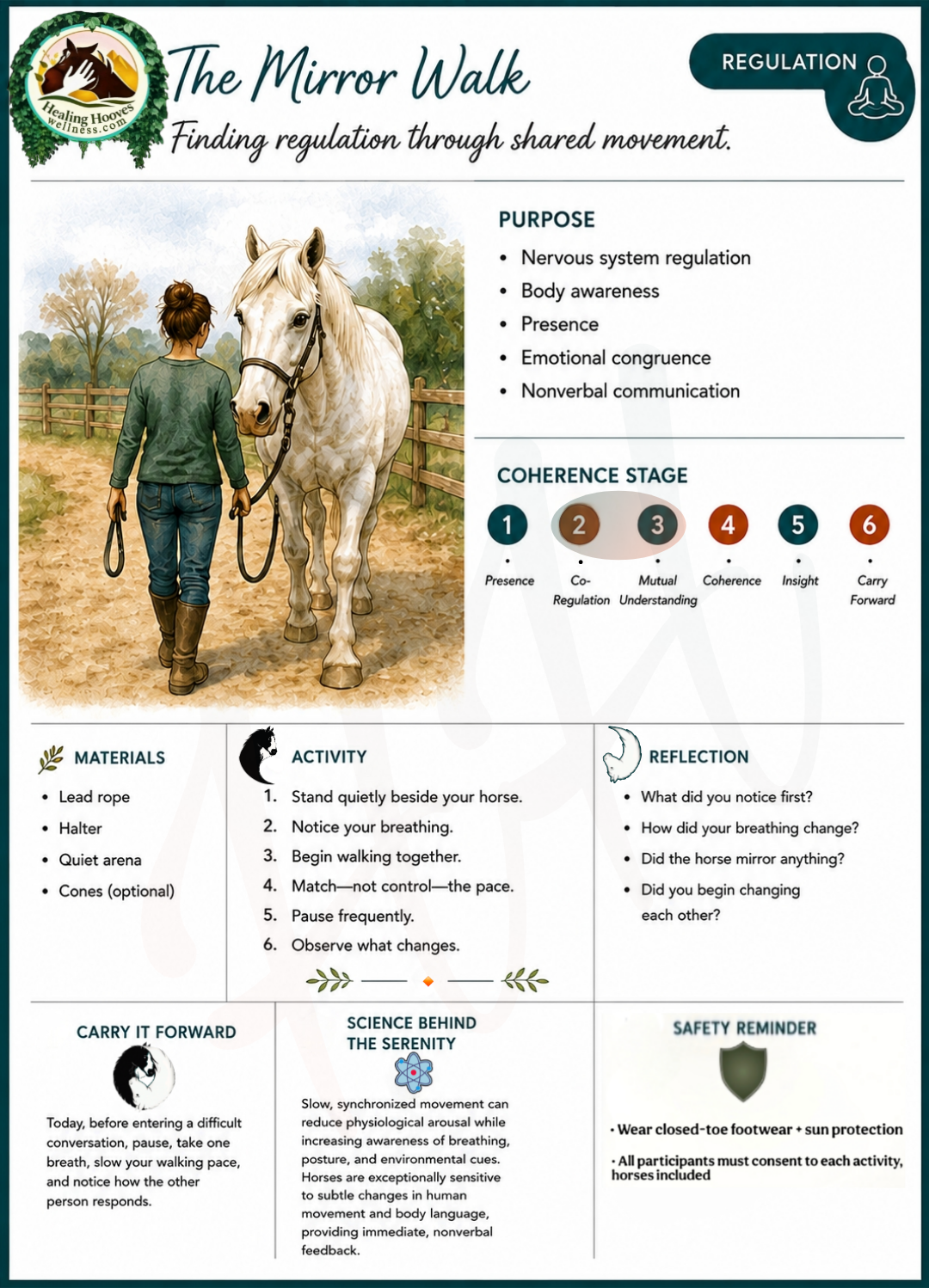
Build confidence, communication, self-awareness, and regulation while learning to move as connected partners. As your connection deepens, you'll practice responding with intention rather than reaction, creating a foundation for insight, resilience, and lasting change.
Walk the Talk
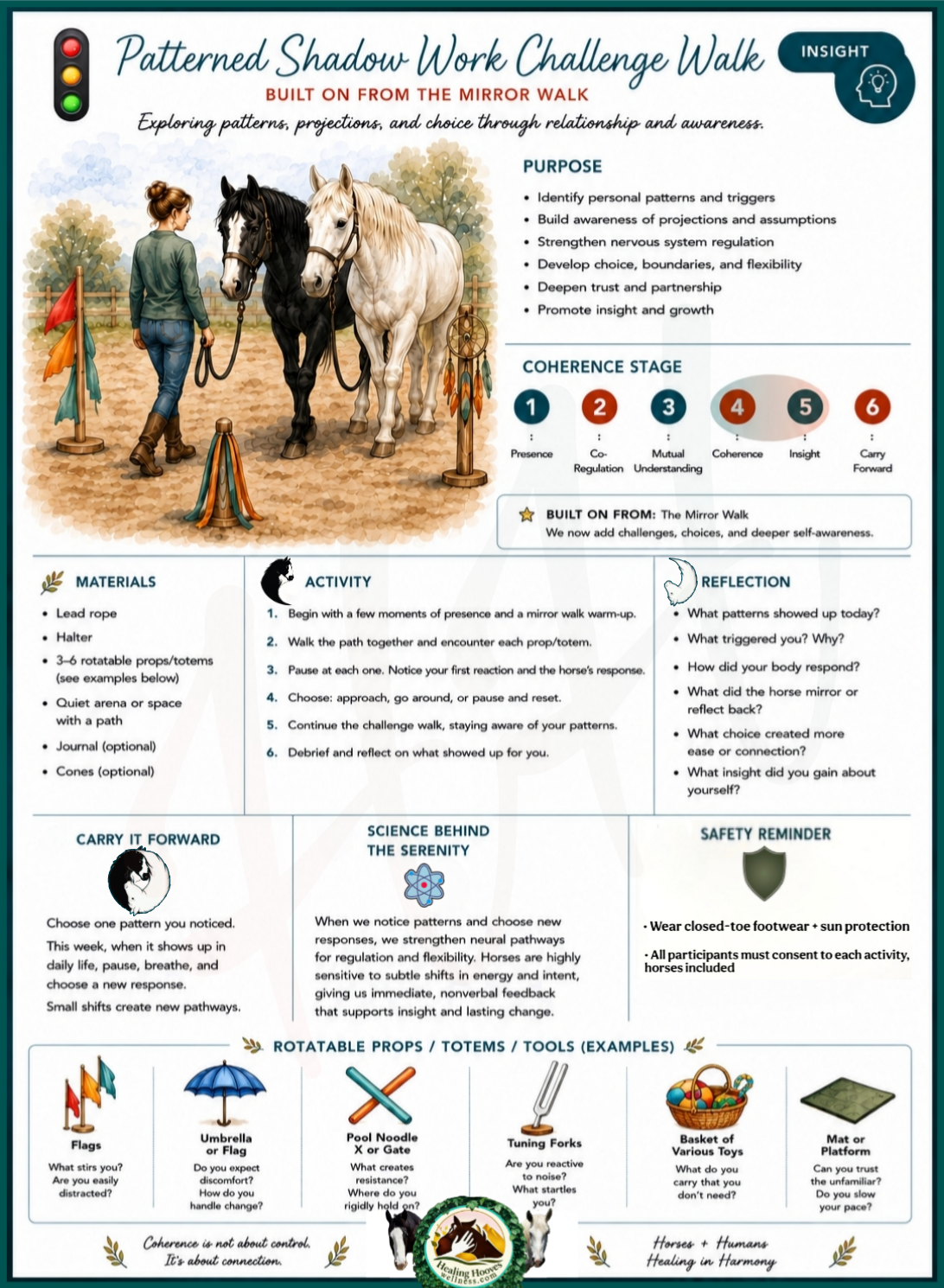
Navigate meaningful obstacles together that encourage self-awareness, flexible thinking, resilience, and intentional choice. Each challenge offers an opportunity to explore personal patterns, build confidence, and strengthen the human-horse partnership.
Rein + Reflect
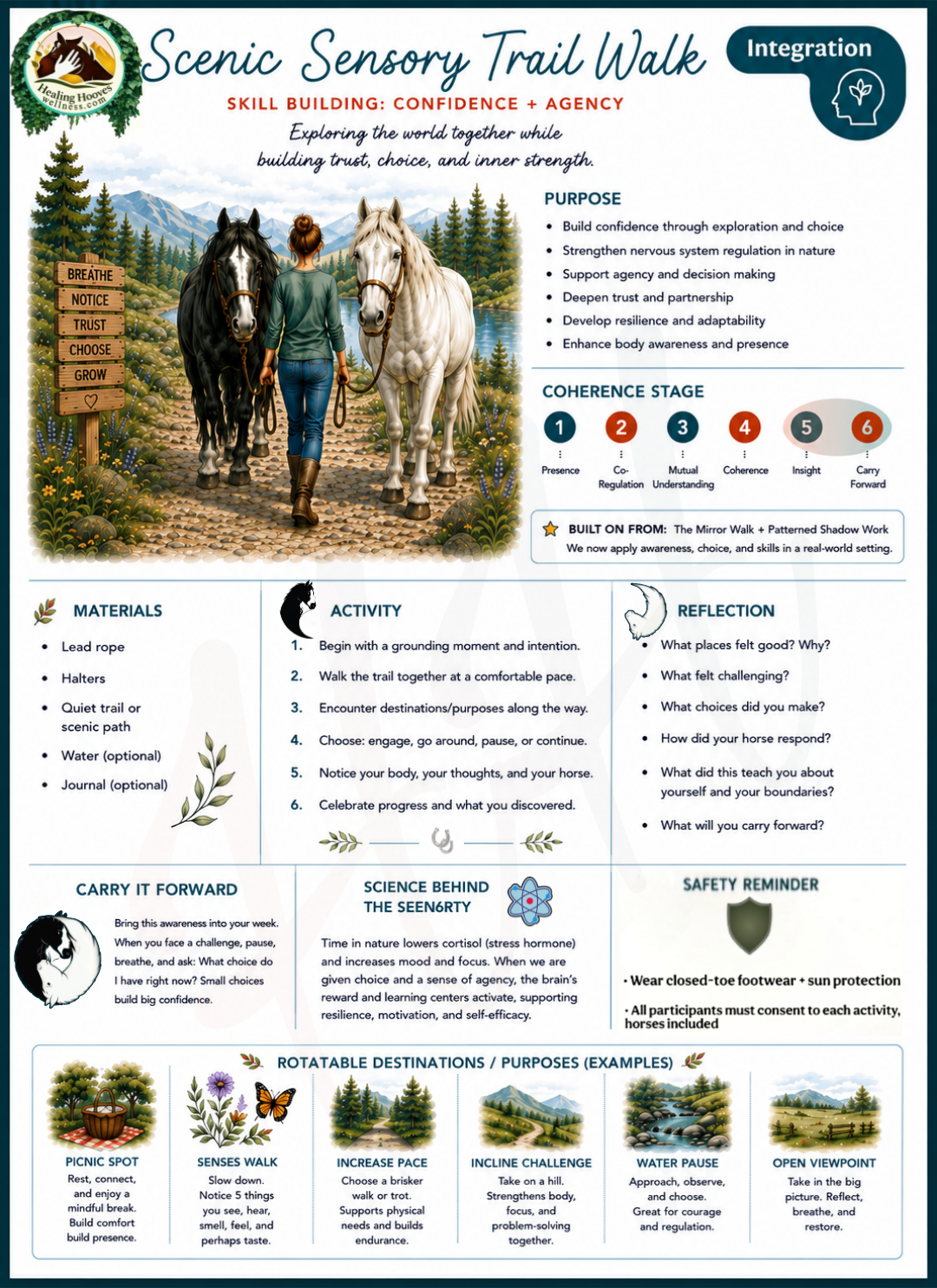
Explore nature alongside our horse while encountering thoughtfully designed destinations that encourage curiosity, confidence, choice, problem-solving, and self-discovery. Every challenge becomes an opportunity to strengthen trust, resilience, and connection.
Purposeful Pathways
The Science
behind
the Serenity
How our work, works.
• FAQs •
Your Questions, Answered
-
Equine-Assisted Therapeutic Activities (EATA) are structured, non-clinical, grounding interactions with horses that support nervous system regulation, relational safety & embodied awareness. All sessions are unmounted while beginning your journey.
What Happens in Your Nervous System
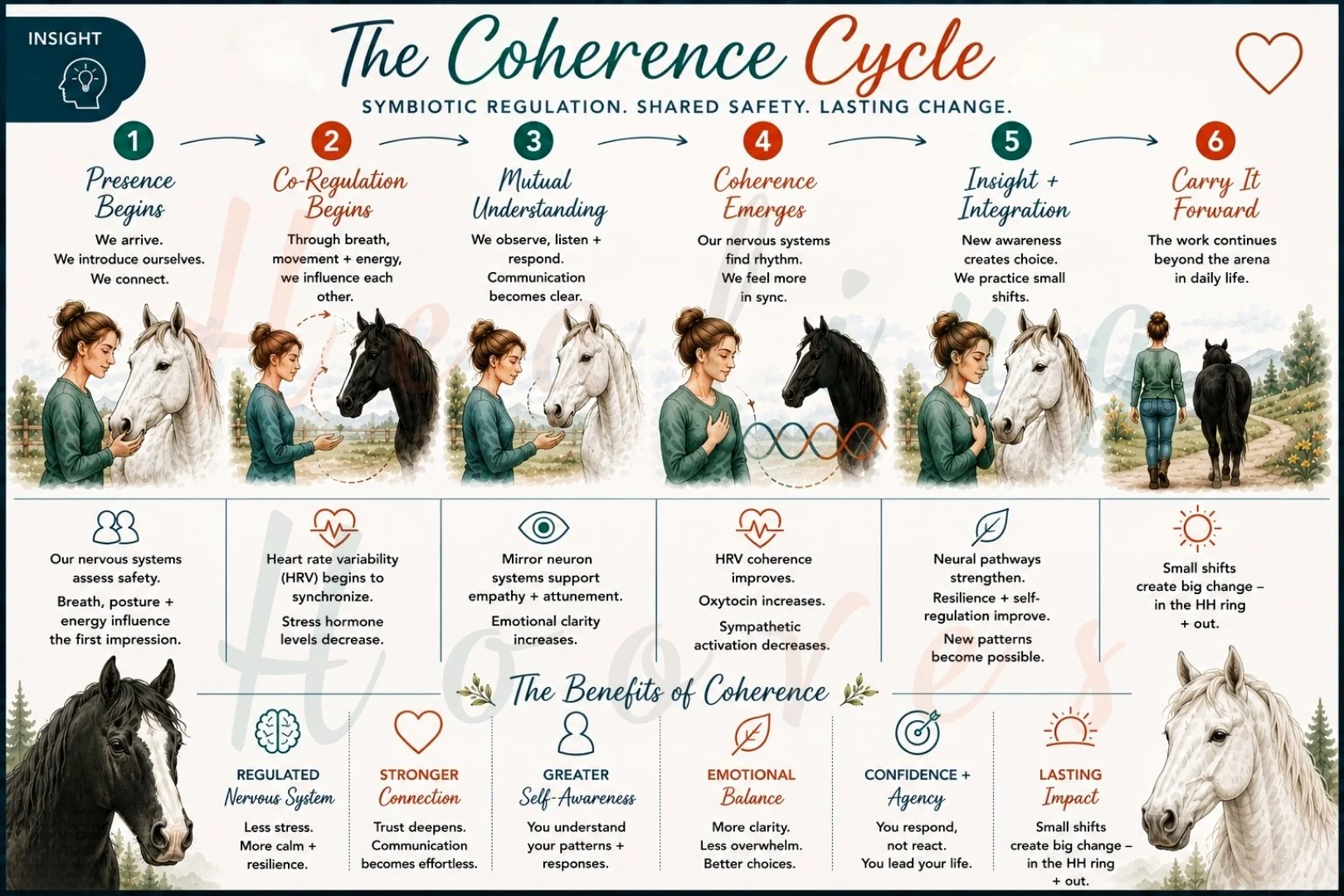
From a psychological & neuroscience perspective, calm & predictable interactions with horses can support regulation of the autonomic nervous system through a process known as co-regulation. When movement slows, attention softens & breathing becomes more rhythmic, the nervous system receives cues of safety. Over time, this can help the body shift out of fight-or-flight or freeze responses & into states associated with presence, connection & choice.
Importantly, this process does not depend on retelling experiences, or explaining emotions. We believe regulation happens through sensation, pacing & relational awareness - often before words are available.
Why This Matters
By working with a calm, attuned horse in a predictable environment, participants can experience regulation, agency & relational safety in real time. These experiences often become reference points the nervous system can return to outside of sessions - supporting confidence, self-trust & a deeper sense of internal steadiness.
-
An HH Session is centered specifically on how the unique human-horse connection can gently, naturally cognitively and physically ground all participants, granting us the opportunity for self-alignment.
What You Will Actually Do
Our EAA sessions are thoughtfully tailored, consent-based, gently paced and adaptive around each participant’s nervous system. Activities may include observing a horse from a distance, grooming, walking alongside, practicing spatial boundaries, or simply sharing quiet space. There is no expectation to perform, accomplish, or “do it right.” Instead, participants are supported in noticing patterns such as:
• how their body responds to closeness or distance
• how boundaries are communicated nonverbally
• how internal states shift when pace, breath, or posture changes
These moments are explored passively, with guidance that helps participants build awareness and choice rather than push through discomfort.
Sessions prioritize:
• noticing proximity + distance
• observing how boundaries are offered, tested, or respected
• tracking subtle changes in breath, posture + attention
• allowing interaction to unfold without urgency or expectation
The horse becomes a living relational partner whose responses offer immediate, nonverbal information about safety, clarity and emotional presence.
-
Our EATA Community-Centered Guided Groups are non-clinical, unmounted, facilitated gatherings that bring people together in shared, horse-present space to support calm, connection, and a sense of belonging.
Informed by research in social neuroscience, trauma-informed care, and group regulation - these experiences recognize that safe, attuned connection within a regulated group can support nervous system settling and reduce isolation. The presence of horses adds a grounding, nonverbal relational element that naturally encourages pacing, awareness, and co-regulation - without needing discussion or disclosure.
Groups are gently guided to prioritize consent, individual boundaries with collective respect, and collective physical and emotional safety. Together, we practice feeling cognitively and physically present in our bodies & in nature, with a small relatable group, in a safely secured environment. Participation is always optional for both human and horses; and sessions are not designed for processing, therapy, or crisis intervention.
-
Equine-Assisted Learning (EAL) builds upon the same horse-human relationship by intentionally developing life skills through specifically structured, guided experiential learning exercises.
Our EAL experiences are designed to strengthen communication skills, emotional intelligence, leadership skills, resilience, confidence, and healthy relationships; and are tailored to each participant’s unique goals.
As HH continues to expand, EAL programs will complement our Equine-Assisted Therapeutic Activities by offering various structured programs.
EAL Focus Areas:
• Communication + Collaboration Skills
• Leadership + Teamwork
• Confidence + Personal Agency
• Problem-Solving + Adaptability
• Healthy Boundaries + Decision-Making
• Resilience through experiential learningOur Philosophy
At Healing Hooves, we don't separate healing from learning.
Many of life's greatest lessons emerge naturally through relationship. Every interaction with our horses offers an opportunity to become more aware, more empowered, and more connected - to ourselves, to others, and to the world around us.
Whether you're seeking regulation, personal growth, or practical life skills, our goal remains the same: progress, not perfection.
-
Our approach is informed by research across neuroscience, human-animal behavior, and trauma-informed learning - which shows that regulated, attuned relationships and environments can support nervous system regulation and personal development.
From a neurobiological perspective, calm, predictable interactions with sensory input (such as rhythm, breath, movement and proximity to nature) can support parasympathetic nervous system activity, and reduce stress responses. Social neuroscience further demonstrates that co-regulation - the process by which one regulated being helps another settle - plays a key role in feelings of safety and connection.
Horses, as highly social, perceptive prey animals, are naturally responsive to subtle changes in posture, muscle tone, and breath. Research in human-animal behavior shows that this sensitivity allows for real-time learning through the immediate, nonverbal feedback within the interaction.
-
Horses are uniquely suited for this work because of how their biology is organized for relationship and collective safety.
As herd-based prey animals, horses survive through continuous monitoring of one another’s body language. They rely on subtle, nonverbal signals - posture, muscle tone, breath, orientation, and proximity - to maintain safety within the group. This sensitivity is not trained, it is innate.
Physiological Coherence, HRV + Nervous System Entrainment
Research in psychophysiology and animal behavior shows that horses have highly regulated cardiovascular and nervous systems, and a larger biological field. Humans engaged with a regulated horse may experience corresponding shifts in breathing and heart-rate variability - a process commonly known as co-regulation or physiological entrainment. These shifts do not require instruction, effort, or verbal processing; they occur through shared rhythm and presence.
For individuals whose nervous systems have learned to remain on high alert, this kind of present-moment interaction can feel settling, awareness, and a felt sense of safety.
Why This Matters for People
Unlike humans, horses do not respond to stories, diagnoses, or explanations. They respond only to what is happening now. This present-state responsiveness allows participants to experience connection without having to perform, disclose, or be understood cognitively.
Horses do not try to fix, reassure, or analyze. They offer clarity through conscious and subconscious honesty - qualities that many people have learned to associate with risk in human relationships.